Your shopping bag is empty



Welcome to the official Musou Black Shop!
Your shopping bag is empty
Hello, everyone!
Today’s topic is about conducting the Oddy Test—a method used to determine whether materials are safe for use in exhibition spaces like museums and galleries—in-house!
Our product line is used across a variety of fields, including art, aerospace, and optical devices. Because quality requirements differ from industry to industry, we often receive inquiries like 'Do you conduct this type of testing?' To meet these needs, we run external tests or collect data in-house whenever necessary. Recently, we received an inquiry asking, 'Have you performed an Oddy Test on "Musou Black Fabric KIWAMI"?'
Since we had no prior knowledge of the Oddy Test, we started by researching it ourselves. We learned that it's a test used by museums and galleries to check whether materials might harm the exhibits they're displayed with. Developed in 1973 by conservation scientist William Andrew Oddy at the British Museum, it's a widely used evaluation method in Western countries. Named after its developer, the Oddy Test checks whether materials emit gases that could corrode metals or otherwise damage artifacts.
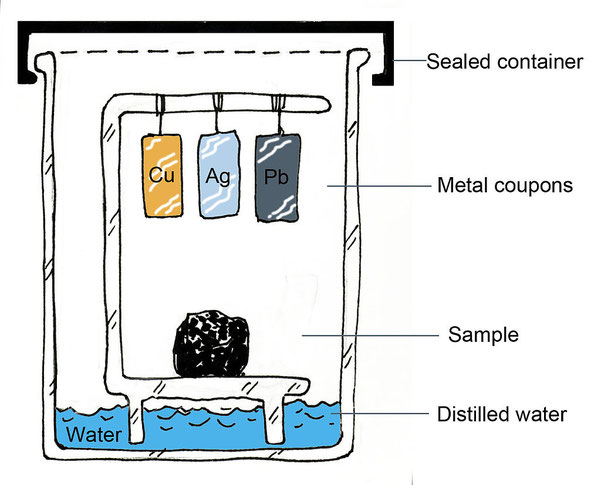
The Oddy Test involves sealing material samples together with metals such as lead (Pb), silver (Ag), and copper (Cu) in the presence of water, then observing whether the metals corrode from gases released by the material. For example, silver tarnishes when exposed to H₂S, while lead and copper oxidize and discolor. The test checks for exactly this kind of reaction.
To run the test, we placed lead, silver, and copper samples in a sealed glass petri dish with water, along with a piece of "MBF KIWAMI". A second petri dish with the same setup—minus the "MBF KIWAMI"—served as our control. Both dishes were kept at 60°C for 28 days, after which we compared the color of the metal samples between the two setups.
Here’s what we found:
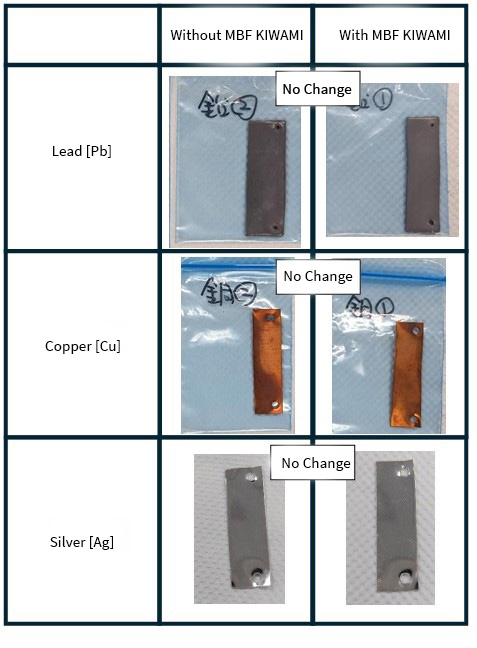
Lead and copper both showed slight discoloration, but there was no difference between the dish with MBF KIWAMI and the control—meaning the discoloration came from the water or heat, not from MBF KIWAMI.
Silver showed no change at all, before or after the test, in either setup.
In short, we found no meaningful difference between the samples with and without "MBF KIWAMI"—a clear pass for the Oddy Test!
With this successful result, the world’s blackest fabric, "MBF KIWAMI", is an excellent choice for museums and galleries. Its deep blackness makes the perfect backdrop for showcasing exhibits at their best. We’d love for curators around the world to consider using it. "MBF KIWAMI" is available through our official store in A4-sized sheets, as well as 1,100mm-wide rolls for larger projects. Stay tuned for our next blog post!

Black materials are often associated with the idea of "absorbing light." In reality, the main reason we perceive something as black ...

Musou Black materials are being used across a wide range of industries, including aerospace development, botanical specimen p...

When designing optical environments, controlling stray light is critical, but not all “black” materials perform the same. Black-coat...

When people hear the phrase “recreating space on Earth,” many imagine a completely dark room. In practice, designing an environment...