Your shopping bag is empty
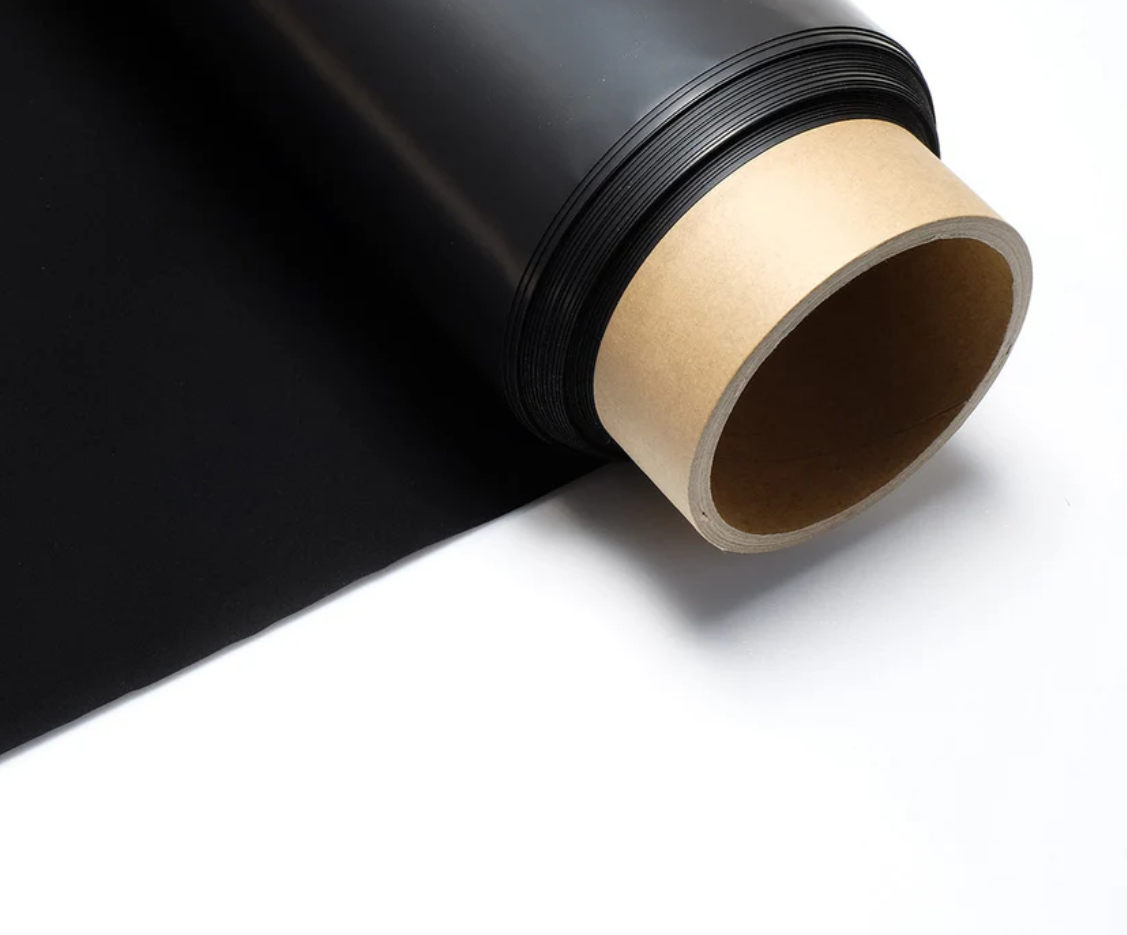
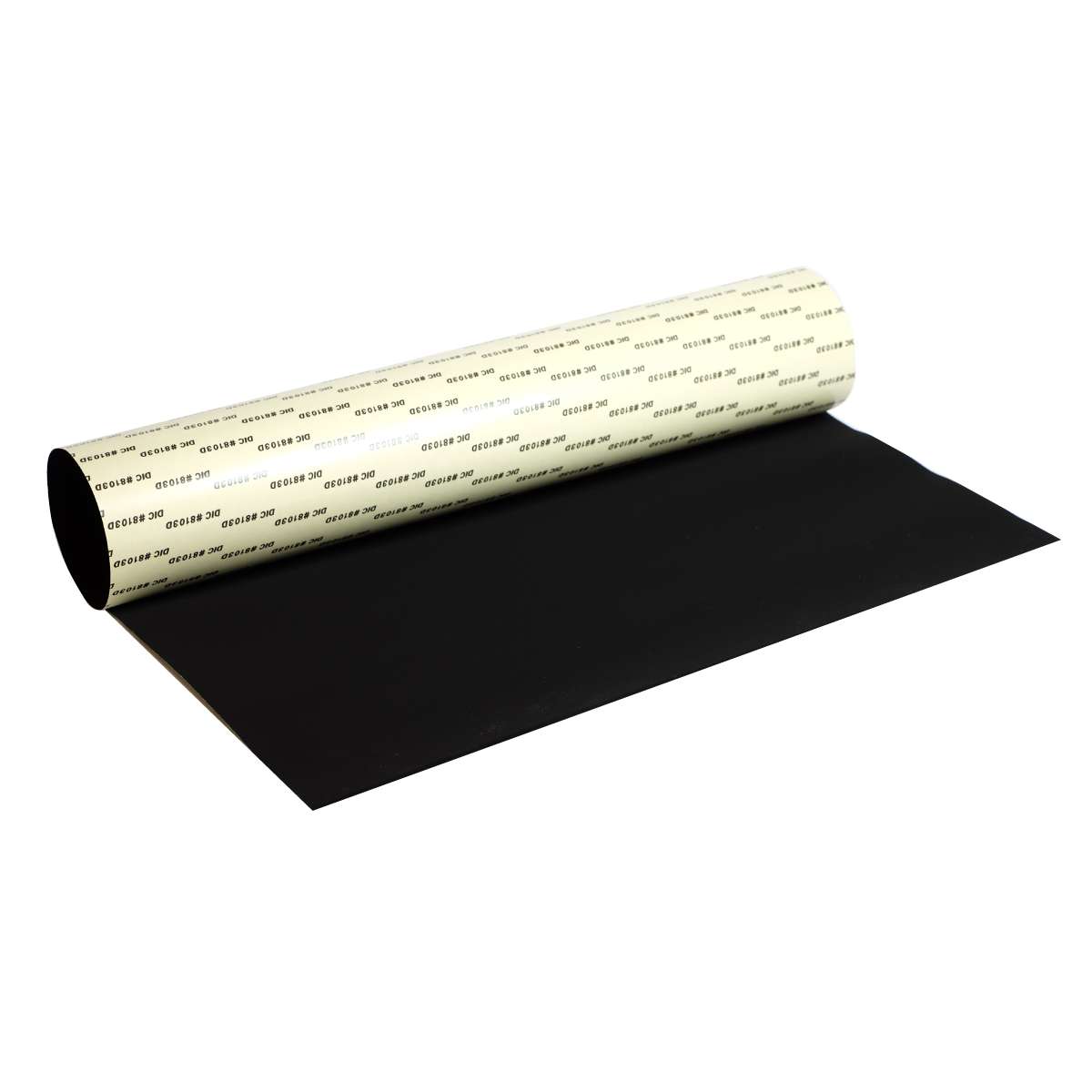
FINESHUT SP
Ultra-thin anti-reflective sheet with exceptional light absorption
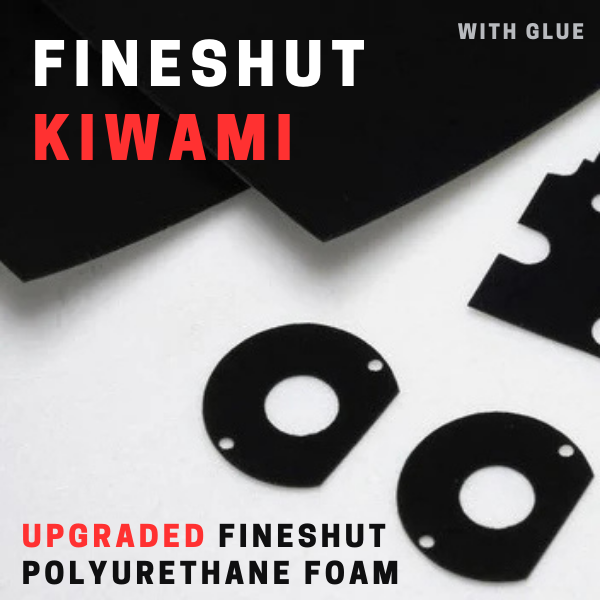
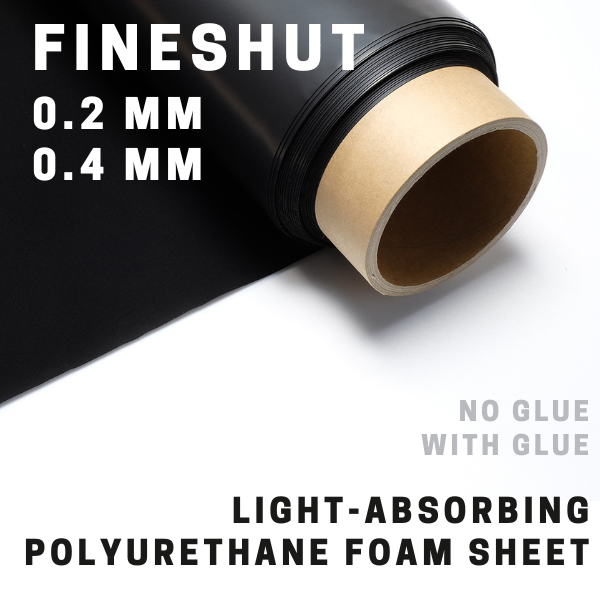
Fineshut SP is an advanced light-absorbing anti-reflective sheet made from microporous polyurethane foam. It was developed for demanding optical applications and reduces stray light and reflections from the visible spectrum into the near-infrared range — with a material thickness of only 0.2 mm or 0.4 mm.
✓ Ultra-thin
Only 0.2 mm or 0.4 mm material thickness — ideal for tight optical systems, sensor environments and compact assemblies.
✓ Fiber-free
No lint formation and no fiber shedding as with conventional flocking materials. This makes it especially suitable for sensitive optical systems.
✓ IR-optimized
High light absorption from visible light into the near-infrared range, ideal for modern cameras, sensors and LiDAR systems.
✓ Sensor-friendly
Can be used in close proximity to sensitive camera sensors because no fibers or particles are released.
Why Fineshut SP?
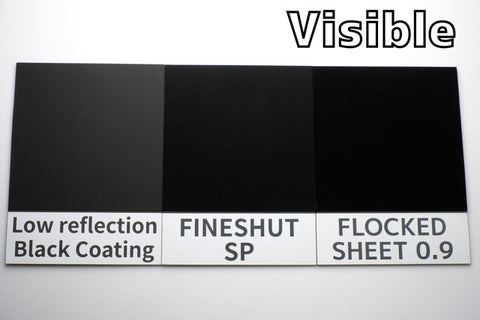
In optical systems, even the smallest reflections can affect image quality, measurement accuracy or sensor performance. Conventional flocking films can provide good results in the visible range, but they may release fibers and often lose absorption performance in the near-infrared range.
Fineshut SP was specifically developed for modern optical applications where a very thin, fiber-free and highly light-absorbing surface is required. Its microporous polyurethane structure allows incoming light to penetrate deep into the surface and absorbs it especially effectively.
This makes Fineshut SP highly suitable for cameras, lenses, sensors, LiDAR systems, spectrometers, telescopes, scientific instruments, industrial machine vision and applications where a clean, stable and low-reflection surface is essential.
Key benefits
- Very thin light-absorbing anti-reflective sheet for technical and optical applications
- No fiber shedding as with conventional flocking materials
- No lint formation or particle release
- Suitable for applications near camera sensors
- High absorption from visible light into the near-infrared range
- Ideal for stray light suppression in optical systems
- Flexible, lightweight and easy to cut
- Available in 0.2 mm and 0.4 mm thickness
- Available with different adhesive options
- Suitable for industry, research, astronomy, sensors and camera technology
- RoHS 2.0 compliant
Application areas
Fineshut SP is suitable for a wide range of optical, industrial and scientific applications. The following sections show typical areas of use and practical examples.
📷 Cameras & lenses
Fineshut SP can be used inside camera and lens housings to reduce unwanted reflections. Typical applications include lens tubes, baffle systems, internal housings and adapters.
Its high light absorption can help reduce contrast loss and minimize unwanted reflections within the optical system.
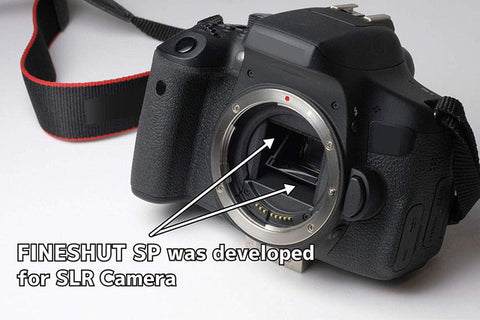
📸 DSLR and mirrorless cameras
Because Fineshut SP does not release fibers, the material is especially suitable for applications near sensitive image sensors.
Typical areas of use include camera bodies, mirror boxes, adapters, sensor chambers and internal light traps.
🔭 Astronomy & telescopes
In telescopes, Fineshut SP can be used to line tubes, baffle systems, secondary mirror holders and camera adapters.
This can reduce internal reflections and improve image contrast in both visual observation and astrophotography.
📡 LiDAR systems
LiDAR sensors often operate in the near-infrared range. Fineshut SP can be used inside sensor housings to minimize unwanted reflections and stray light.
This can help improve signal quality and increase the accuracy of optical measurements.
🛰 Optical sensors
Optical sensors benefit from controlled light guidance. Fineshut SP can be used inside sensor housings to reduce internal reflections.
This is particularly useful for highly sensitive measurement applications.
🔬 Spectrometers
In spectrometers and optical analysis instruments, Fineshut SP helps reduce unwanted reflections within the optical path.
This can improve measurement accuracy and minimize background signals.
⚙ Scientific instruments
Fineshut SP is suitable for photometers, calibration systems, optical test benches and many other scientific instruments.
Its low material thickness allows it to be used even in very compact assemblies.
🤖 Machine vision systems
In industrial machine vision systems, stray light can affect detection performance.
Fineshut SP helps optimize optical conditions inside camera systems and inspection stations.
💡 Stray light suppression
Fineshut SP can be used as a light-absorbing internal lining to reduce unwanted stray light in optical housings, baffles and light channels.
This is especially helpful when high contrast, stable measurements or reproducible optical conditions are required.
🎥 Optical imaging systems
Optical imaging systems benefit from an environment with as few reflections as possible.
Fineshut SP can be used in housings, light channels and optical assemblies to improve contrast and image quality.
🏭 Industrial inspection systems
Automated inspection systems require stable optical conditions for precise measurement results.
Fineshut SP can help reduce disturbing reflections inside inspection stations and camera systems.
🧪 Research & development
Fineshut SP is frequently used in research projects where a highly absorbing and fiber-free surface is required.
Typical areas of use include optical development, laser technology, sensors, astronomy and scientific instrumentation.
Fineshut SP vs. conventional flocking film
| Property | Fineshut SP | Conventional flocking film |
|---|---|---|
| Fiber shedding | No | Possible |
| Particle formation | No | Possible |
| Material thickness | 0.2 mm / 0.4 mm | Usually significantly thicker |
| IR absorption | Very high | Can decrease in the near-infrared range |
| Use near sensors | Very suitable | Only suitable to a limited extent |
| Typical application | Optics, sensors, LiDAR, cameras, measurement systems | General stray light reduction |
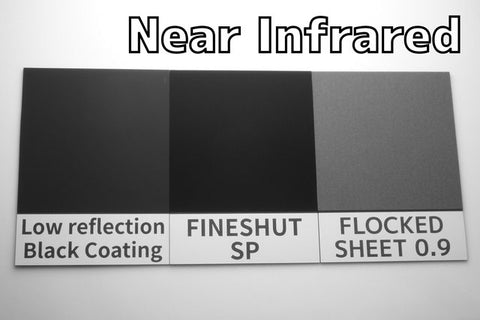
Stable light absorption from visible light to near infrared
Many black materials appear very dark in the visible range, but reflect significantly more light when used in the near-infrared range. This can lead to unwanted stray light, especially in cameras, sensors, LiDAR applications and scientific measurement systems.
Fineshut SP was developed to provide high and stable light absorption across a broad wavelength range. This makes the material especially suitable for applications where both visible light and near-infrared light need to be controlled.
This property makes Fineshut SP especially interesting for modern optical systems in which sensors operate not only in the visible range but also in the near-infrared range.
Microporous surface structure
The special performance of Fineshut SP comes from its microporous polyurethane surface. This surface consists of a large number of ultra-fine pores and recesses that allow incoming light to penetrate deep into the material structure.
Instead of being reflected directly from the surface, light is scattered and absorbed multiple times inside this microscopic structure. This results in exceptionally low residual reflection — despite the extremely low material thickness.
Because Fineshut SP does not use fibers, it does not create lint or particles. This is a major advantage over conventional flocking materials, especially in sensitive optical assemblies, camera systems and measurement instruments.

Ideal for optical systems with tight tolerances
Thanks to its low material thickness of 0.2 mm or 0.4 mm, Fineshut SP can also be used where conventional flocking films would be too thick or too prone to fiber shedding. This makes the material especially interesting for compact optical assemblies, camera housings, sensor environments and precision measurement instruments.
Fineshut SP can be cut and installed in housings, baffles, tubes, sensor environments or optical spaces to reduce stray light and improve contrast.
Why fiber-free material is so important
In high-quality optical systems, loose fibers or particles can be a serious problem. They can contaminate sensors, affect measurements or cause visible artifacts in camera systems.
Fineshut SP avoids this risk through its fiber-free foam structure. This makes it particularly suitable for applications where cleanliness, stability and optical reliability are critical.
Technical specifications
| Product | Fineshut SP |
| Material | Microporous polyurethane foam |
| Available thicknesses | 0.2 mm / 0.4 mm |
| Adhesive layers | 0.05 mm / 0.15 mm / without adhesive |
| Optical application | Stray light suppression, anti-reflection, light absorption |
| Spectral range | Visible light to near infrared |
| Fiber-free | Yes |
| Suitable for sensor environments | Yes |
| RoHS compliance | RoHS 2.0 |
Choosing the right version
Fineshut SP is available in different thicknesses and adhesive variants depending on the application. The thinner 0.2 mm version is especially suitable for very tight installation spaces, while the 0.4 mm version provides a slightly stronger material base.
Depending on the surface and mounting method, Fineshut SP can be selected with a thin adhesive layer, a stronger adhesive layer or without adhesive. For industrial applications, it is recommended to test suitability on the respective substrate in advance.
Product video
Frequently asked questions
Is Fineshut SP the same as conventional flocking film?
No. Fineshut SP is based on microporous polyurethane foam and is fiber-free. Conventional flocking films use fibers that can detach under certain conditions.
Can Fineshut SP be used near camera sensors?
Yes. Since the material does not release fibers, it is especially suitable for applications near sensitive sensors.
Is Fineshut SP suitable for infrared applications?
Yes. Fineshut SP is designed for high light absorption from the visible spectrum into the near-infrared range.
Can the material be cut to size?
Yes. Fineshut SP can be cut to fit optical assemblies, baffles, housings or tubes.
Which thickness should I choose?
For very tight installation spaces, 0.2 mm is often ideal. For applications where slightly more material thickness is desired, 0.4 mm can be useful.
Professional stray light suppression for modern optics
Fineshut SP combines exceptional light absorption, minimal material thickness and a completely fiber-free surface. It is an ideal solution for demanding applications in industry, science, astronomy, machine vision and camera technology.

* When viewed by the naked eye, each person's perception of "blackness" may differ depending on the lighting environment and other conditions.
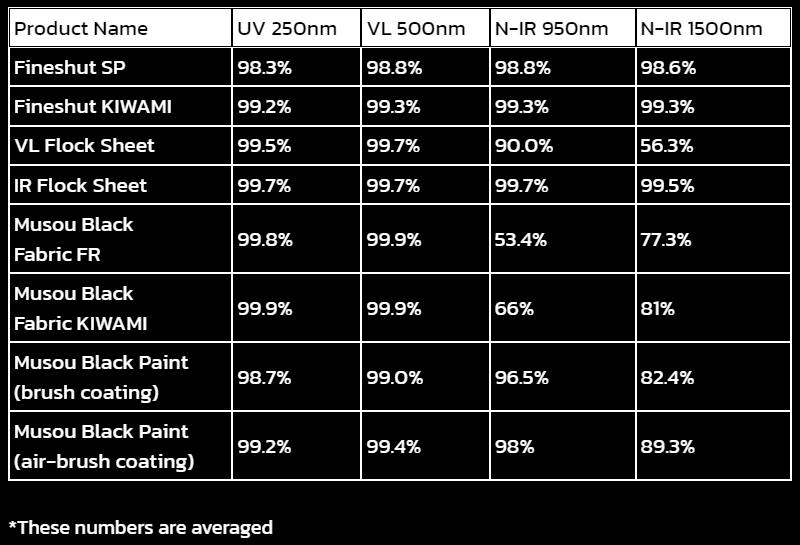
Total reflectance values of our materials are based on the industry-standard AOI 8° index. Total reflectance is the measurement result of combining both diffuse reflection and specular reflection measurements. AOI 8° means that the light is incident at an angle of 8° from the normal.
For example, based on this index, our "Foam" series consistently absorbs light from ultraviolet to near-infrared light ranges. This performance is achieved by the uneven structure derived from the foaming process and the composition of carbon atoms blended into the resin.
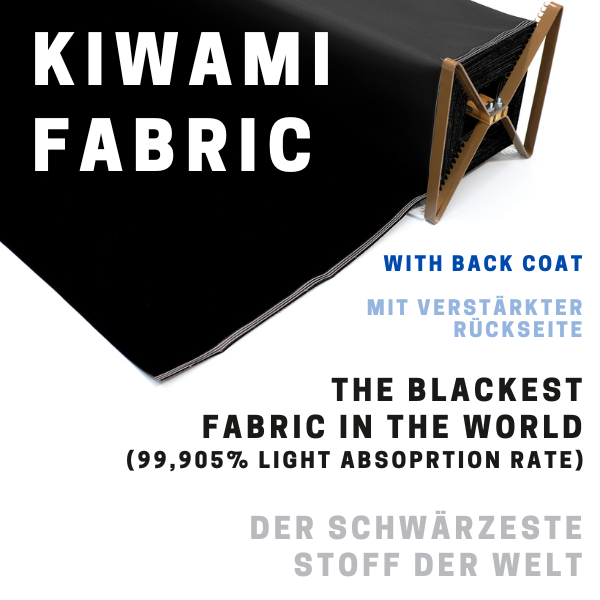
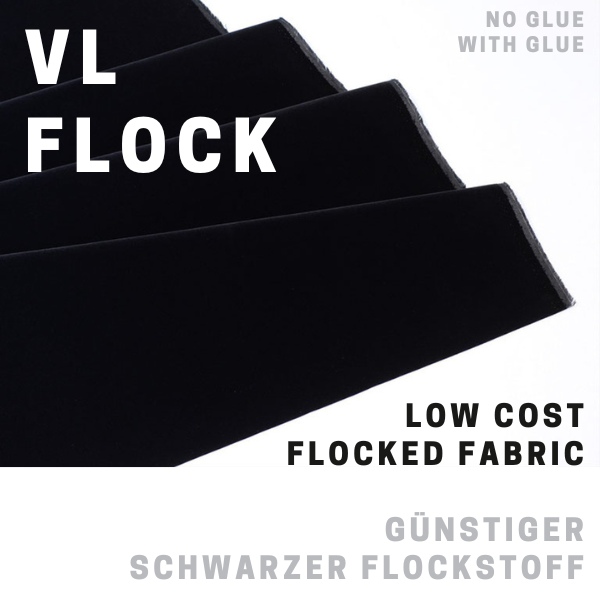
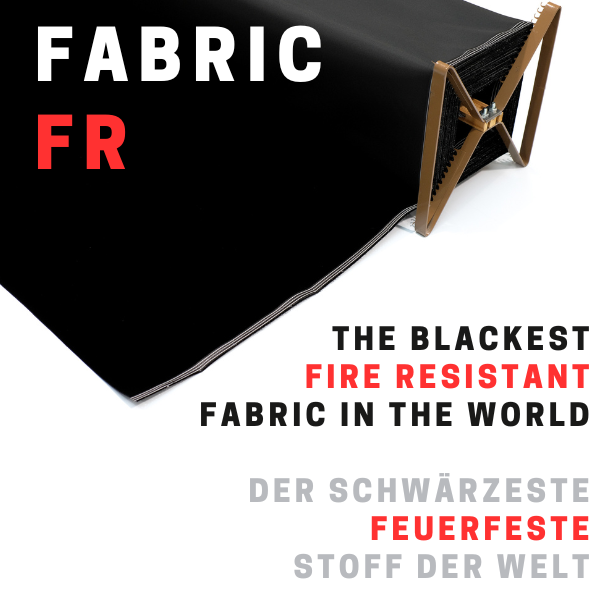
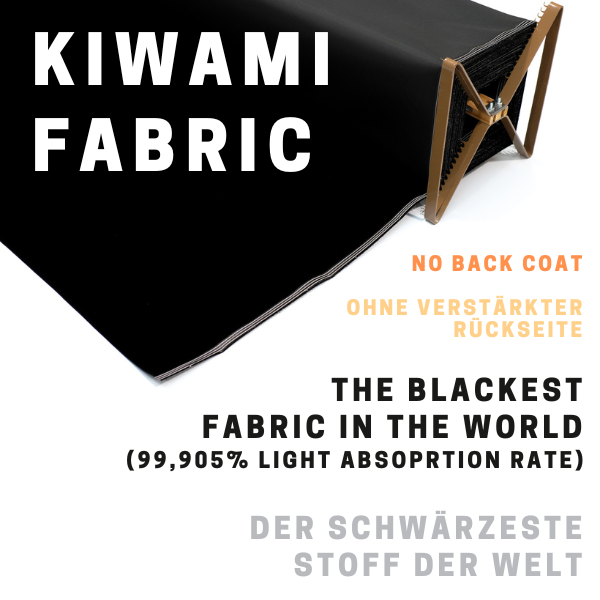
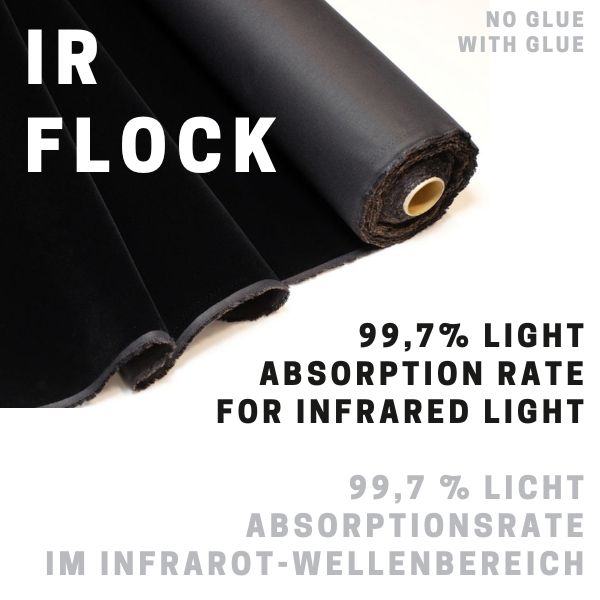
We also offer a variety of fabrics. Our entry-level “VL Flock Sheet” is cost-effective and provides strong light-absorption performance in the visible light range. In contrast, our “IR Flock Sheet” provides improved ultraviolet and excellent infrared light-absorption performance, which are the weak points of the entry-level VL Flock Sheet. Our premium fabrics, Musou Black Fabric FR and Musou Black Fabric KIWAMI, are our blackest products and have the best visible-light absorbing performances. The FR variant is treated to be fire-resistant and is great for indoor use. Meanwhile, our flagship, Musou Black Fabric KIWAMI, is the World’s Blackest Fabric in the visible-light range.
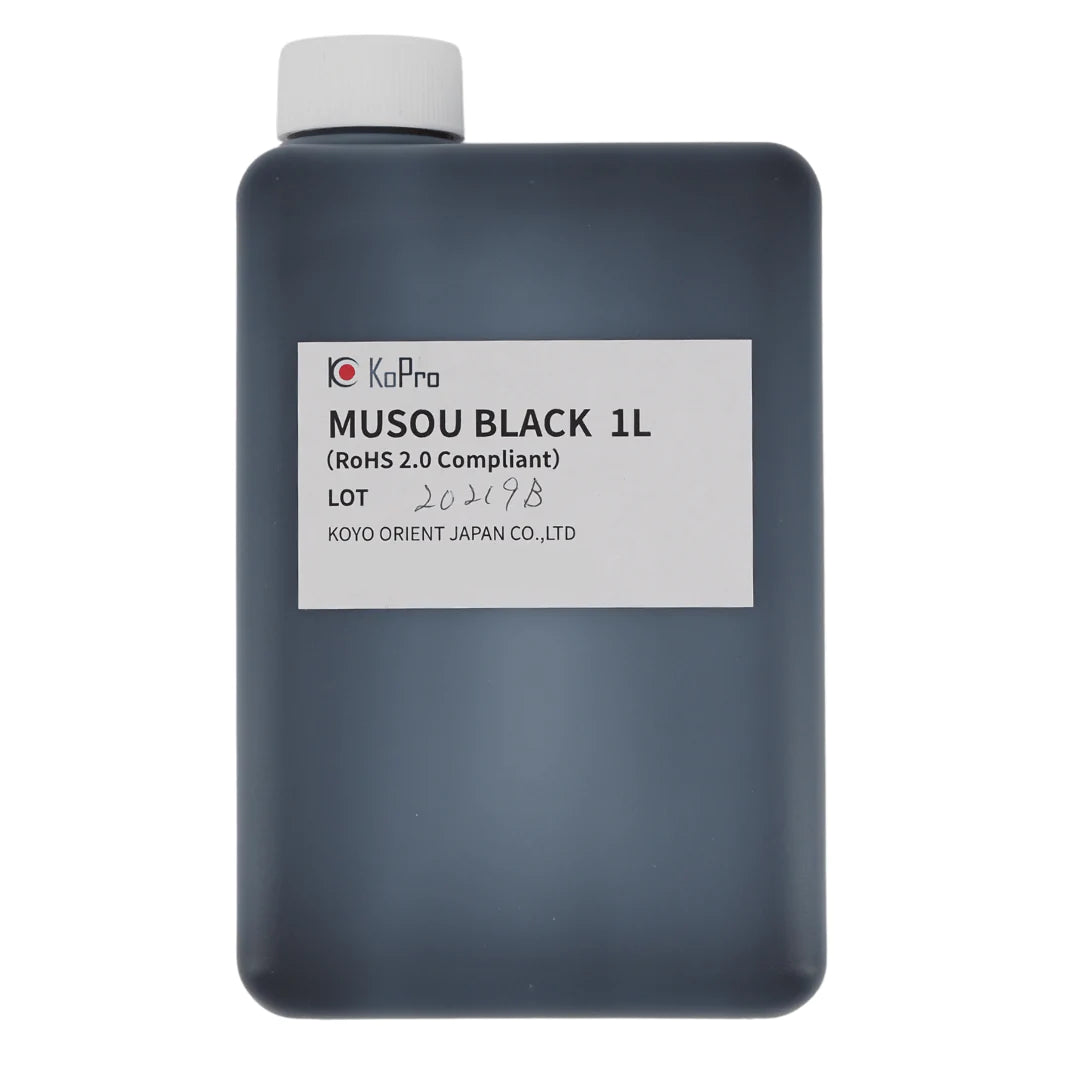
Musou Black Paint's light-absorption performance will vary depending on the painting method, so please keep that in mind when applying. For best results, please apply with an air-brush.